

- m3.com 電子書籍
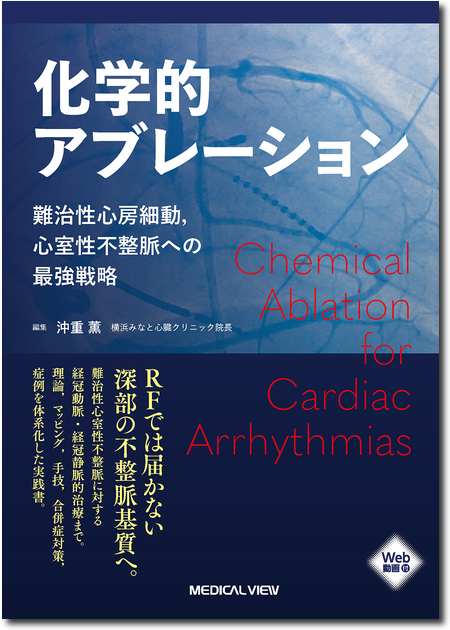
- 化学的アブレーション[Web動画付]


商品情報
内容
本書では,化学的アブレーションの歴史や作用機序,使用機材などの基礎知識から,Marshall静脈へのエタノール注入(VOM-EI)を用いた難治性心房細動治療,心室頻拍・心室期外収縮などの心室性不整脈への応用,合併症とその対策までを体系的に解説。豊富な図版や実際の症例を通して,具体的な手技と治療戦略,安全かつ効果的に施行するための工夫を詳述する。
化学的アブレーションの導入を目指す医師から,さらなる治療技術の向上を志す熟練医まで,幅広く役立つ一冊。
Pedro Brugada先生,Miguel Valderrábano先生による推薦文を収載。
序文
Foreword
“Targeted drug therapy for cardiac arrhythmias is conceptually attractive, though perhaps difficult to achieve. Chemical ablation by intracoronary injection of caustic agents is a start, but should be considered only as a beginning in this challenging area. Transcoronary chemical ablation is an investigative step in the right direction, and Brugada et al. are to be commended.”
D. Zipes, Circulation 1990;81:1139–1141.
In 1987, Inoue, Waller, and Zipes reported in JACC the effects of intracoronary phenol and alcohol on experimentally provoked ventricular tachycardia in dogs. The above words were written by D. Zipes in an editorial commenting on our first experiences with the chemical ablation of ventricular tachycardia (1989) and AV conduction (1990) using intracoronary alcohol.
The 1980s were still difficult times for the treatment of cardiac arrhythmias. Cardiac electrophysiologists were desperately searching for curative treatments because of the limited success of antiarrhythmic drugs. At that time, radiofrequency (RF) ablation was still in its infancy. Its efficacy and potential benefits were not yet clear. It would take several more years before electrophysiologists began exploring RF ablation for ventricular tachycardia. There was an additional problem that should not be forgotten: in the 1980s, primary angioplasty was virtually nonexistent. The first report by G.O. Hartzler on primary angioplasty appeared in 1983 and was poorly received by the medical community. Thus, it would still take years before we would see the practical disappearance of the massive myocardial infarctions suffered by our patients with ventricular tachycardia in the 1970s and 1980s.
Confronted with these patients, who had extremely poor myocardial function and were usually condemned to die in cardiogenic shock because of incessant ventricular tachycardia resistant to all available drugs, I obtained compassionate permission from my institution to try alcohol ablation as a possible last, life-saving resort. And it worked! We also successfully used ethanol to ablate AV conduction through the AV nodal artery in patients with atrial fibrillation and uncontrollable ventricular rates.
Meanwhile, techniques for RF ablation improved and began to dominate the field of catheter ablation for cardiac arrhythmias. Good news for millions of patients worldwide. Transcoronary chemical ablation became somewhat forgotten—but not entirely.
In patients with ventricular tachycardia after myocardial infarction, congestive or hypertrophic cardiomyopathy, or diseases such as Chagas disease, the substrate for the arrhythmia is completely different from that found in Wolff–Parkinson–White syndrome or AV nodal reentry tachycardia, in which a single, discrete, microscopic conducting pathway can usually be readily eliminated with an RF application. Nonfocal ventricular tachycardia may involve multiple substrates and multiple conducting pathways in the same patient. These pathways can be located anywhere within the myocardium—endocardially, intramurally, or epicardially—and may also involve the myocardium transmurally. RF ablation has had rather disappointing success in these situations. Alcohol ablation through the coronary artery supplying the arrhythmogenic area has the advantage of producing immediate transmural tissue injury and therefore represented an alternative to RF ablation that, in some cases, had to be revisited.
Dr. Okishige is to be congratulated on this book. It comes at a time when major advances have been made not only in our understanding of the substrate of cardiac arrhythmias, but also in the techniques used to treat them, particularly in the field of imaging. CT, MRI, three-dimensional mapping, and artificial intelligence have fully entered the electrophysiology cath lab. This is an ideal moment to reassess the value of chemical ablation for cardiac arrhythmias and to give this technique the place it deserves in our therapeutic armamentarium.
This book will be of interest to all professionals and future professionals involved in clinical electrophysiology, from medical, nursing, engineering, and technical students to experienced professionals in the field.
Pedro Brugada, MD, PhD
Emeritus Professor of Cardiology
Brussels, Belgium / Puerto Banús, Spain
Foreword
I was largely ignorant about the world of ethanol ablation when the idea of using chemical ablation to treat arrhythmogenic mechanisms of the ligament of Marshall crossed my mind. The idea was rooted in work by Peng-Sheng Chen at Cedars-Sinai Medical Center in Los Angeles, where I had worked for several years, along with his -mostly Asian- research fellows, who became lifelong friends. After preclinical validation, initial human studies started in 2008, which were met with old-fashioned skepticism (or plain dismissal) from the scientific community.
However, a few Asian electrophysiologists showed some interest. I was invited to perform vein of Marshall ethanol ablations in Seoul in 2010 by Dr. Young-Hoon Kim, an old friend from Dr. Chen’s laboratory.Some procedures are remembered for their outcomes; a few are remembered for the room in which they happened and the people that were there. Among those who came to watch was Dr. Kaoru Okishige. When we injected ethanol into the vein of Marshall and perimitral block appeared on the screen, the audience broke into applause, to my embarrassment and amusement. Applause is not a common sound in an electrophysiology laboratory, and I suspected it was meant more for the ethanol than for me.
What I did not know then was that one of the most attentive observers in the room would go on to become the world’s most experienced operator in the technique. In hindsight, that should not have surprised me. Dr. Okishige's interest in chemical ablation long predates my work in the vein of Marshall: as this book recounts, he was among the early investigators of transcoronary ethanol ablation of ventricular arrhythmias, working with Peter Friedman in Boston. He came to Seoul not as a novice, but as a physiologist recognizing an old idea in a new vessel.
Since then, he has pioneered the use of the technique for mechanistic studies of pharmacological modulation of atrial fibrillation, and validated its use in combination with cryoablation and radiofrequency ablation. He also led the Asian experience of venous ethanol for ventricular arrhythmias, reaching substrates that thermal energy cannot reliably reach. This book gathers that body of work, from the history and tissue biology of ethanol injury, through equipment, chemical mapping, and technique, to case studies and future directions, into a single practical volume.
In a world where medical research is driven by industry's financial interests, Dr. Okishige's rigor, inquisitive mind, and insightful contributions are an inspiration for those of us who remain fascinated by the anatomy and physiology parts of cardiac electrophysiology. Ethanol costs almost nothing, and no company stands to profit from it. Its adoption has depended entirely on physicians willing to do the careful, unglamorous work of proving that it works, and understanding why.
This book is a landmark contribution to the field. Books like this remind us that we as physician-scientists have a moral duty to inch the field forward with whatever contribution we can make, no matter how small in scope, to preserve the true motivation of medical science, which is to improve the care of our patients with better understanding and better treatments, regardless of the financial motivations.
For me, this is a story of science, patient care, and above all, friendship. It has been an honor to cross paths with Dr. Okishige in my professional life. I am grateful to have been in the room that day in Seoul, and honored to introduce this book.
Miguel Valderrábano, MD, PhD
Lois and Carl Davis Centennial Chair
Chief of Cardiac Electrophysiology, Houston Methodist DeBakey Heart & Vascular Center
序文
1988年頃,不整脈専門医としてbreakthroughを模索していた私は,海外へそれを求めました。米国のいくつかの施設へアプローチを行い,結果的にHarvard Medical Schoolの関連病院の一つである,ボストンのBrigham and Women’s Hospital(BWH)への研究留学を決めました。同病院は過去にWPW症候群のWol 医師やWhite医師が在籍し,私が着任した当時もLown分類で有名なBernard Lown医師が健在で,何よりもEugene Braunwald医師が現役トップに君臨していた活気ある時代でありました。Pedro Brugada教授の指導を受けたPeter L. Friedman教授がBWHで不整脈治療法として化学的(ケミカル)アブレーションの研究を行っていることに興味を持ち,research fellowとして応募し,受け入れていただきました。
1989年に渡米した最初の仕事は,当時BWHのresearch fellowとして私の同僚であったPaul J. Wang医師(現Stanford大学循環器科教授,Circulation Arrhythmia & Electrophysiology誌のeditor-in-chief )とともに,ケミカルアブレーションの動物実験を行うことでした。その後,臨床研究に携わりましたが,厳寒のボストンの深夜にBWHから呼び出され,急性冠症候群に合併した心室頻拍への緊急ケミカルアブレーション治療を施行したことも,今となっては懐かしい思い出であります。
帰国後,着任した横浜赤十字病院にて大変な苦労の末にIRB審査を通過し,本邦でもケミカルアブレーションを施行し,発表いたしました。しかし,当時は結構なバッシングを受けました。それから20年近くを経て,Miguel Valderrábano医師が開発したMarshall静脈へのケミカルアブレーションが,心房細動治療として脚光を浴びることになったのは非常に感慨深いことでした。心室性不整脈に対し,経冠動脈法のみならず,最近では冠静脈経由のケミカルアブレーションも開発され,高周波アブレーションなどでは治療が困難な症例に活用されることとなりました。
私の手技を見学する目的で非常に多くの医師が訪問されまして,ケミカルアブレーションを施行する施設もかなり拡充しました。しかし,それでもいまだに見学希望の医師が途絶えないことや,本治療の出張依頼が後を絶たないことなどを聞くにつけ,本治療法の健全で安全な普及のためにも,この段階でテキストを発刊すべきであろうと考えました。
本書の執筆は,本邦の気鋭の不整脈専門医の方々にご依頼し,皆さまに快くお引き受けいただきました。こうして斯様な素晴らしい本の発刊に漕ぎつけることができたのは,望外の喜びであります。不整脈専門医の方々の日々の診療に本書が少しでも役立てば,編著者としまして幸甚に存じます。
2026年10月
沖重 薫
横浜みなと心臓クリニック院長
目次
第1章︱総論 化学的アブレーションの基礎
1 化学的アブレーションの歴史
高周波カテーテルアブレーションの限界 佐々木毅
化学的アブレーション黎明期 沖重 薫
2 エタノール注入の組織傷害メカニズム
エタノールによる心筋壊死の機序 佐々木毅
RF病変との相違点(境界,均質性,深達度) 井川 修
3 必要な機材と薬剤の準備
使用するエタノール注入用バルーンカテーテルおよびガイドワイヤーの選択 石村昌之
エタノールの濃度と注入量,注入方法,病変容積規定因子 石村昌之
治療効果の検討に必須となる画像診断 石村昌之
4 化学的マッピング
房室結節 沖重 薫
Marshall静脈 沖重 薫
心室頻拍 沖重 薫
第2章︱各論Ⅰ Marshall静脈エタノール注入療法
1 臨床的効果および影響:基礎的観点からも踏まえて
Marshall静脈(VOM)/靱帯(LOM)の解剖学と発生学 井川 修
病変部の経時的変化 沖重 薫
僧帽弁輪峡部(Mitral Isthmus)ブロック作成におけるVOMの重要性 川口直彦
化学的アブレーションの適応 吉谷和泰
心房性不整脈,心臓自律神経系への影響 慶田毅彦
CFAE(complex fractionated atrial electrograms)および心外膜側脂肪組織に与える効果 沖重 薫
2 手技の実際
内頸静脈および大腿静脈アプローチ法 佐々木毅
CSへのカニュレーションと造影,VOMの同定法 慶田毅彦
ワイヤー操作・バルーン留置・エタノール注入プロトコル̶ボルドー方式とValderrábano・沖重系アプローチの比較̶ 滝川正晃
エンドポイントの判定
①局所電位の変化 川口直彦
②僧帽弁輪峡部における伝導ブロックの確認方法 山下修平,高月誠司
3 EI-VOMの合併症とトラブルシューティング
冠状静脈洞・VOM解離,エタノール漏出(back flow),心タンポナーデなど 鎌倉 令
4 EI-VOMによる心房細動治療の長期成績 佐々木毅
第3章︱各論 Ⅱ 難治性心室性不整脈に対する化学的アブレーション
1 難治性VTの分析
RFアブレーション不成功例(intramural VTなど)の解析 小松雄樹
標的となる冠静脈解剖 白井康大
2 マッピング戦略
microelectrode catheterによるマッピングと化学的マッピング 白井康大
3 手技の実際
冠動脈内エタノール注入による化学的アブレーション 小松雄樹
冠静脈内エタノール注入による化学的アブレーション 白井康大
4 合併症とその予防
発生機序と発生状況 加藤千雄
全体像と分類 加藤千雄
第4章︱ 症例集(Case Study)
1 Marshall静脈化学的アブレーション編
標準的なmitral isthmusブロック作成成功例 吉谷和泰
Marshall静脈が極端に細い/屈曲している難渋例 石村昌之
Redo症例におけるEI-VOMの活用 姫野優貴弘,高月誠司
2 VT化学的アブレーション編
筑波大学方式:冠静脈内細径電極カテーテルを用いた心筋深部基質の同定と選択的冠動脈化学的アブレーション 小松雄樹
Brigham & Women’s 病院方式:経冠静脈的化学的アブレーション 沖重 薫
左室頂上部起源心室性不整脈に対するsummit veinへの注入例 白井康大
難治性心室頻拍(VT):長期成績と予後改善の工夫 加藤千雄
中隔深部VTに対する経冠動脈化学的アブレーション 小松雄樹
第5章︱今後の展望
1 新しいデバイス・技術との併用(PFAなど) 川口直彦
2 化学的アブレーションの将来的な位置づけ 矢野修平,高月誠司
便利機能
- 対応
- 一部対応
- 未対応
- 全文・
串刺検索 - 目次・
索引リンク - PCブラウザ閲覧
- メモ・付箋
- PubMed
リンク - 動画再生
- 音声再生
- 今日の治療薬リンク
- イヤーノートリンク
- 南山堂医学
大辞典
リンク
- 対応
- 一部対応
- 未対応
対応機種

iOS 最新バージョンのOSをご利用ください
外部メモリ:27.5MB以上(インストール時:61.9MB以上)
ダウンロード時に必要なメモリ:110.1MB以上

AndroidOS 最新バージョンのOSをご利用ください
外部メモリ:27.5MB以上(インストール時:61.9MB以上)
ダウンロード時に必要なメモリ:110.1MB以上
- コンテンツのインストールにあたり、無線LANへの接続環境が必要です(3G回線によるインストールも可能ですが、データ量の多い通信のため、通信料が高額となりますので、無線LANを推奨しております)。
- コンテンツの使用にあたり、m3.com電子書籍アプリが必要です。 導入方法の詳細はこちら
- Appleロゴは、Apple Inc.の商標です。
- Androidロゴは Google LLC の商標です。
書籍情報
- ISBN:9784758324427
- ページ数:272頁
- 書籍発行日:2026年11月
- 電子版発売日:2026年11月13日
- 判:B5判
- 種別:eBook版 → 詳細はこちら
- 同時利用可能端末数:3
お客様の声
まだ投稿されていません
特記事項
※ご入金確認後、メールにてご案内するダウンロード方法によりダウンロードしていただくとご使用いただけます。
※コンテンツの使用にあたり、m3.com 電子書籍アプリが必要です。
※eBook版は、書籍の体裁そのままで表示しますので、ディスプレイサイズが7インチ以上の端末でのご使用を推奨します。
